07 RAG Ops
TL;DR
RAGOps Stack
-
purpose ⟶ enable deployment/maintenance/optimization
-
composed of 3 groups of layers:
#1. Critical Layers (foundation of system operation)
-
Data ⟶ {Ingest, Transform, Store}
-
Model ⟶ {Embeddings Models, Foundation Models, Task-Specific Models}
-
Model Deployment ⟶ {Fully Managed, Self-Hosted, Local/Edge}
-
App Orchestration ⟶ {Multi-Agent Orchestration, Workflow Automation}
#2. Essential Layers (quality, safety, performance)
-
Prompt
-
Evaluation
-
Monitoring
-
Security & Privacy
-
Caching
#3. Enhancement Layers (for adaptability & efficiency)
-
Human-in-the-Loop
-
Cost Optimization
-
Explainability
-
Collaboration & Experimentation
These 3 layers form a progressive architecture.
System flow: Data ⟶ Model ⟶ Deployment ⟶ Orchestration ⟶ Evaluation ⟶ Enhancement
1. Critical Layers
-
definition: Foundational components required for a RAG system to operate.
-
includes the following layers
Data
-
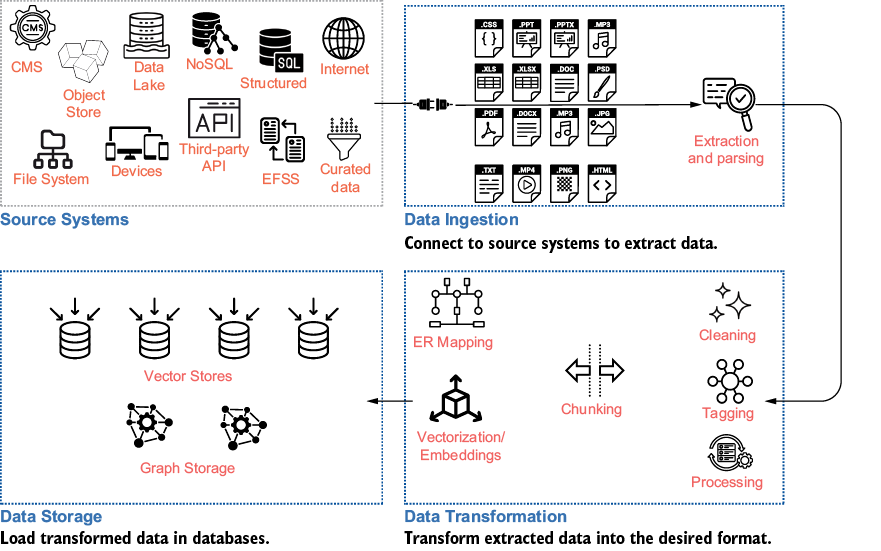
function ⟶ create & manage the KB.
-
composed_of ⟶ {Ingestion, Transformation, Storage}
-
feeds ⟶ Model Layer
Model
-
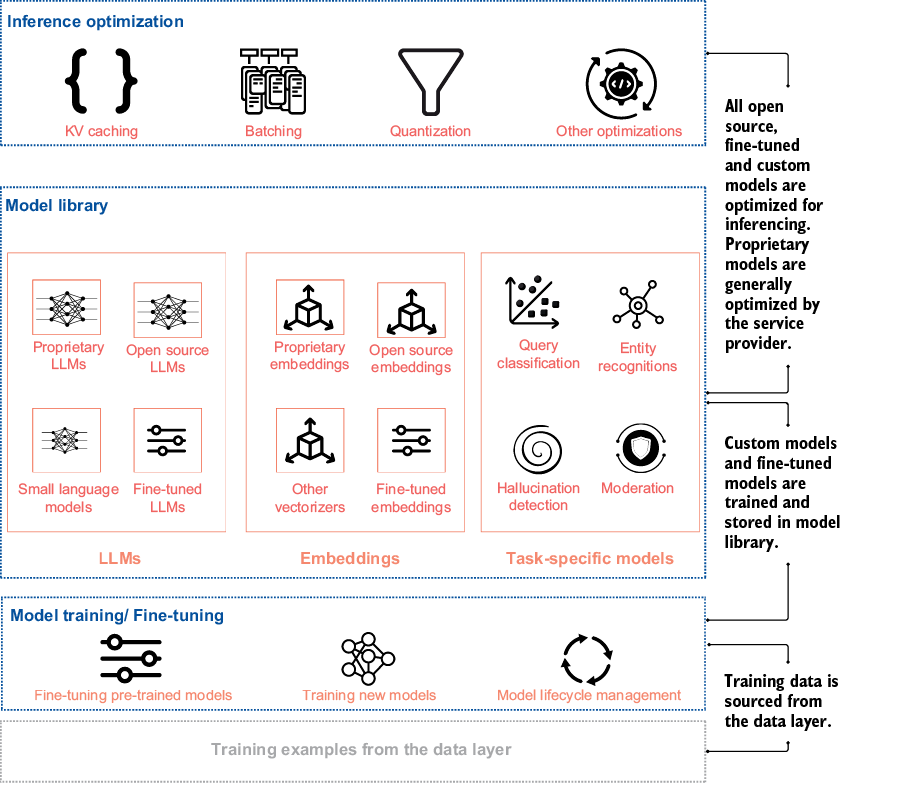
function ⟶ transform/generate/evaluate content.
-
composed_of ⟶ {Embeddings Models, Foundation Models, Task-Specific Models}
-
interacts_with ⟶ Data Layer & Deployment Layer
Model Deployment
-
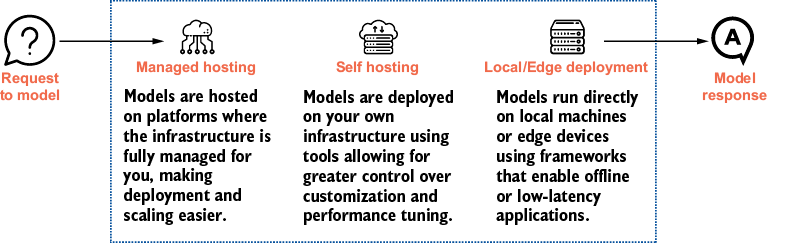
function ⟶ host & serve models
-
deployment_modes ⟶ {Fully Managed, Self-Hosted, Local/Edge}
-
enables ⟶ efficient inference
App Orchestration
-
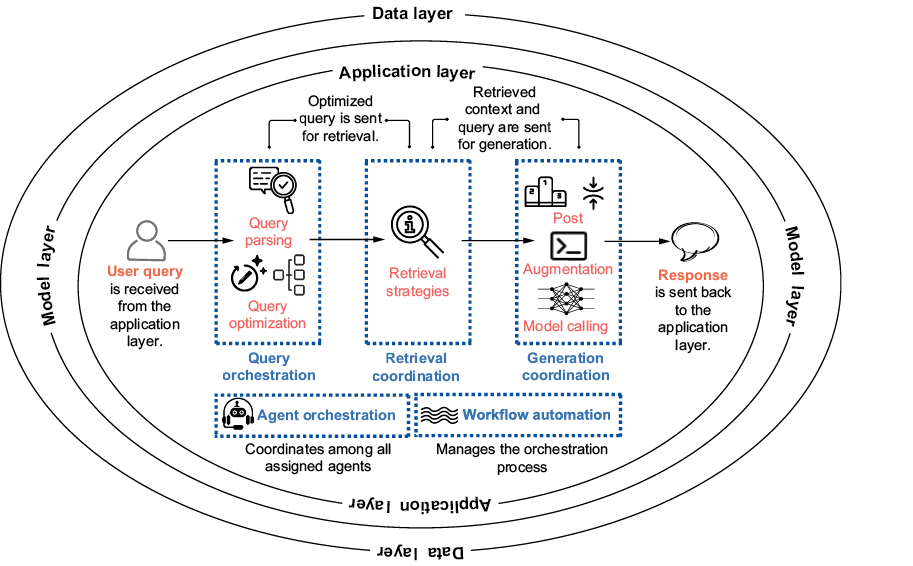
function ⟶ coordinate flow between Data & Model layers.
-
subcomponents ⟶ {Q Orchestration, R Coordination, G Coordination}
-
extended_by ⟶ {Multi-Agent Orchestration, Workflow Automation}
2. Essential Layers
-
definition: Support layers ensuring performance, reliability, and safety.
-
includes the following layers
Prompt
- function ⟶ guide LLM behavior through effective prompt design.
Evaluation
- function ⟶ assess retrieval accuracy and response quality.
Monitoring
- function ⟶ track latency, health, and model behavior over time.
Security & Privacy
-
function ⟶ protect data integrity and user privacy.
-
methods ⟶ {Anonymization, Encryption, Differential Privacy, Guardrails}
Caching
- function ⟶ store frequent queries and responses to reduce latency and cost.
3. Enhancement Layers
-
definition: Optional layers that improve scalability, usability, and oversight.
-
includes the following layers
Human-in-the-Loop
- adds ⟶ expert verification and ethical oversight.
Cost Optimization
- optimizes ⟶ infrastructure and inference resources.
Explainability
- provides ⟶ transparency for regulated or high-stakes domains.
Collaboration & Experimentation
- enables ⟶ shared development and iterative improvement.
Production Best Practices
Sam
Techniques to improve reliability & UX.
-
Hybrid filtering (for latency): Combine multiple retrieval filters.
-
Validation loops (for hallucination): Run post-R or post-G checks before answering.
-
Autoscaling: Dynamically adjust compute resources.
-
Fine-tuning: Tune on domain-specific examples.
-
PII Masking: Replace PII with placeholders before storage.